These were the "Words of the Day" that were on my Google Homepage today. I guess it's fitting, since today I can officially say that I am being appointed to a new church.
For the Conference year 2006-2007 I will be serving as an Associate Pastor at Trinity UMC in Huntsville of the new Northeast District.
I am leaving Weeden Heights UMC in Florence, which I have served for four years since graduating seminary.
I'm excited, Laura's excited, my family is excited (I hope the people of Trinity are excited) for this new opportunity. We're going to be going through a lot of changes over the next few months, but we feel that this is the right move and the right thing to do. The area is still growing and will be a wonderful place of opportunity for both Laura and I.
Leaving Weeden is bittersweet, especially when they are at such a crossroads in their life. But I hope and pray that I have planted enough seeds and nurtured enough gifts there so that they might experience life and vitality once again. The church will always hold a special place in my heart, not only as my first appointment, but the church I was serving when Laura and I got married. There have been ups and downs, but definitely a lot of learning.
Here's to being agog with excitement of where the itinerant ministry may lead, with the hope and trust that caveat is not needed.
Sunday, April 23, 2006
Interesting choice of words

Thursday, April 20, 2006
Note
I've been busy - I guess. I've finally published some of the Panama entries, so you'll have to look back in the archives to see them. They posted to the date that I orginally started them.
-M
Where you from, Boy?
Your Linguistic Profile: |
| 45% Dixie |
| 40% General American English |
| 10% Yankee |
| 5% Midwestern |
| 0% Upper Midwestern |
For most of my life, people have asked me where I was from. Not because I looked strange or anything, but the question comes after hearing me speak.
As it turns out, apparently I don't sound like I am from here the South at any rate. To hear us talk (and to see us, for that matter) you would never know that my sister and I were related. Her Southern/Haleyville accent is definitely recognizable to the ear. Not only do I not fit in with my family that way, but my lack of drawl has led a lot of people to initially treat me with suspicion. I've been treated as an outsider because people have thought I was a Yankee or something because I didn't sound like Pa Kettle. (And by the way, when spell check sees "Haleyville" as a mispelled word, it suggests "hillbilly" as a replacement. So you know that that has to mean something about where I'm from.)
So what happened? Why do I talk this way? Two things. One, my parents encouraged both my sister and I to use proper English grammar it's a source of pride and confidence, as well as a sign of respect to the person that you are talking to. And two, when I was a child, I had a pretty severe speech impediment.
Apparently a genetic trait that was passed down from my great grandfather on my mother's side, male babies are sometimes born with attached tongues. Lift up your tongue, notice the skin that is under there, mine went all the way to the tip of my tongue. When I began to speak, it was impossible for me to say certain sounds like "th," "l," and "d." Somewhere between 4 and 6 my parents noticed the problem and I had my tongue clipped to help me speak better. (Bet you didn't know that you could have your tongue circumcised did you?)
After that, I had to go to speech therapy to relearn how to talk. So, with that, along with my parents encouraging us to speak well, I lost my "Southern" talk.
One of the most interesting events that has happened related to this was last year when doing my CPE residency at UAB Hospital. I was on call late one night and an African-American family had been called in to be told that their 50-year old ex-husband/brother/son had died from a massive heart attack. I was there to comfort the family and to "babysit" them because the ER docs didn't want to deal with them while they waited on other family members to travel in so that they could see the body.
The night turned into a comedy of errors as later, unknown to the family, the body was moved from the ER to the morgue. Granted, the ER needed the room, but some of the family members were waiting to go back there to see the decedent with the traveling family before leaving to go make arrangements. Typically, I would imagine in most hospitals, making arrangements with the morgue (or "Decedent Services") would be easier. Not at UAB.
The morgue had just been moved to a new area, along with many other locations that had been changed due to new construction. Going from old to new wasn't a problem for me since I didn't know the old locations, but apparently everyone at UAB Hospital was having a really tough time with the learning curve. Even the people who worked in their respective departments had trouble giving directions to where they were.
We found locked doors, walked through 2 parking decks, and took elevators that you could get on but not off and still never saw this family's loved one. After about 2 hours of this and my constant apologizing for the difficulties and the run around that I was getting by the UAB staff, they decided to just give up. "Mama" of the family was in a wheelchair and could only take so much.
The family was so appreciative, even though their time there was futile and frustrating, and they had just lost someone they loved. But they thanked me nonetheless. As they were leaving, one of the older brothers in the family asked me where I was from. It caught me off guard, because at that time it seemed like a really random question, but for some reason, thinking that he was implying that I didn't have a southern accent, I replied. "I had a speech impediment growing up." (As a side note, I was getting the question asked a lot as I was visiting with different patients there at the hospital.)
As it turns out, and after reflection with my CPE Supervisor, this man was probably really asking the question, "What's this young white guy doing - going out of his way to help us when no one else would in this hospital and not like most of the white folks we meet in this city." Now I've probably exaggerated a little bit, but you get the gist. It wasn't the sound of how I talked or my accent that made an impression on them, it was a voice of compassion and caring of the Spirit that they heard.
When we speak with God's voice of love, then people truly do hear something completely different. So, where you from, boy?
Tuesday, March 07, 2006
There's a feeling in the air
If only things were as "feeling right this time of year," as Better Than Ezra put it.
The grass is growing again. The birds are chirping. And I am stuck inside, encouraged not to talk about a major transition that is coming up in Laura and my life.
Yes, you guessed it, the first round of appointments have begun. I have come to realize in the last few weeks, that this is one of the most unhealthy processes that could be attached to ministry. Laura chides me for taking this long to realize it, but by growing up Methodist, there were a lot of assumptions that I looked over until now.
One of the few things that I do feel I can safely say is that it is certain that we will be moving this year. The church's membership and attendance has declined (through several deaths and people needing to move into full-time care facilities) so much that they can no longer afford even the minimum salary for an elder in full connection.
Honestly, before I was appointed here, the church was already at this point, and it has been a true testament to the strength and character of these people that they have been able to make it this long. But this dedication to meet the financial requirements for the conference and to cover the staff salaries has taken its toll on them and has also locked up resources that could have been used to encourage growth and outreach. Hopefully, with the church being able to lower its salary and Conference askings, they will be able to have at least a little more funds to put towards more outreach.
But, even though we know for certain that we will be moving, there is no indication of where that may be. I do know of a few possibilities, though, which helps. One of the new practices this year has been for potential Associates to "interview" with senior pastors in churches where they may be sent. Of the places I have gone, I have felt comfortable there and can see great potential for ministry.
But, the reality is, that not even these "possibilities" are guaranteed. Granted, all of this is better than the past two years when all along, we had been told that we were staying and then two weeks before Annual Conference we were told to start packing (both moves fell through due to a communication breakdown between the District Superintendents and the churches).
And so I am stuck. Only being able to say a lot of nothing as we prepare to go somewhere. I may have even said too much even with this, because Laura can't really tell her employers anything.
I'm not angry or bitter, nor am I even surprised at the process. I knew what I was getting into when I answered the call to ministry. The problem that I have is the way in which the covert nature of the Cabinet and the itineracy system contributes so much to a feeling of mistrust and isolation for pastors and churches.
So we have three months. Three months to wonder, wander, and wait. I guess it's fitting that most of this happens during Lent - wandering through the wilderness and waiting on a call from the devil.
I am excited about new opportunity and possibility, and I know that wherever we go, we will have a great ministry. And hey, I've been given a pretty good sign all will work out well.
Wednesday, January 18, 2006
Panama: The Purpose
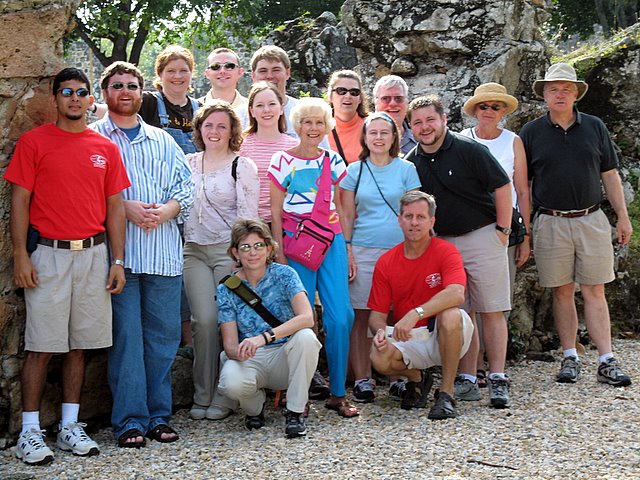 The purpose of our trip was multi-fold: (1) for young clergy (plus Leisha) to get to know Bishop Willimon better, (2) for us to be trained as team leaders for future UVIM trips, (3) to find out more about what the North Alabama conference is doing in missions (particularly Panama), (4) and to keep Patsy Willimon from spending another birthday depressed because it falls so soon after Christmas.
On all counts, the trip was a success. We got to know the Bishop about as much as we wanted to. Really thoug, the greatest part was getting to know other young clergy (plus Leisha) better. Being in the Florence District, clergy in the 20-30 age range are few and far between (only one other elder, plus two student pastors). In addition, my age group is not only noticeably absent in churches, but also in the community. (Florence wants to be the state's premier retirement community.) As a result, direct interaction with peers can be quite limited for Laura and me. So, being able to spend a week with other young clergy was quite a refreshing time.
The time with the Bishop wasn't quite what I had expected. The trip was billed as a time to get to know the Bishop and be mentored by him. Turns out, he was more interested in using the time as a vacation and to test out ideas on us. Case in point, in one of his last email letters he writes about "Affinity Clusters," referring to the re-districting. Well, we heard his ideas on that during one of his many breaks from painting.
In college nor seminary, I was never one to seek out the professor after class just for the sake of he or she getting to know me. There were a few that I did get to know well, but I was never one of those "front row" people. So it was with our time on the trip. I got more than enough time for me to spend with him, but there were certainly others that sought out every minute they could with him, particularly "The Infector" who was our translator and is a lay person - not that he didn't have a right to talk to the Bishop.
As I said, I feel that the time I got to spend with the Bishop was more than adequate. My appointment for the coming year was not made or broken with the trip (at least I hope). Plus, he really does have a short attention span. Many times someone would be talking to him, would make a point, and he would say, "Hmm." and then walk away on to something else. Even our time at the Panama Canal was rushed because he didn't want to waste time waiting for the English version of the Canal video to be shown. But enough about that.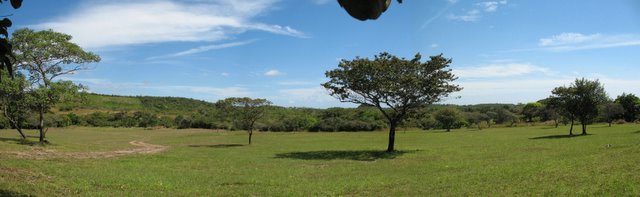
The other part of the trip, the information and training about UVIM (United Methodist Volunteers in Mission) was also good. I would definietly like to go back and lead a team to work longer than we were able to. There is going to be plenty of opportunity to work, especially with the plans to build a camp at the above location.
Panama: Sight-Seeing and Customs
Franklin Durado Yes, not many people would include a picture of a hardware store in their collection of "sight-seeing" pictures, but mine wouldn't be complete without "The Big Orange."
We spent a lot of time at this hardware store. Not to disparage Paulette or anything, she had entirely too much on her plate, but we got to know the insides and out of "The Big Orange." Eerily similar to a Home Depot in color and design (despite Patsy Willimon referring to it as "Lowe's," but so much more different than any hardware store I had ever been in. They had everything from your general hardware and home improvement items, to exercise equipment, athletic equipment, and musical instruments.
The Pacific Ocean
 Since the country of Panama runs West-East (or, East-West the way we first traveled), the southern coast is their Pacific Coast. We stopped here on our way to David for a nice 3-hour lunch. The scenery was beautiful, every picture that I took turned out amazingly. As Laura said, "It's kind of hard to screw up a picture of something so beautiful."
From what I could gather, this was a bit of a resort area where there seemed to be many Panamanian people at the beach as well as a good helping of international vacationers.
Old Panama
 This is a picture of a now ruined Cathedral in Old Panama, one of the first settlements in the country. Tragically, the location was not as strategically located as the founder would have liked and the city was sacked in the early 1600s, I think.
One of the neat things about this ruin is that apparently seven different orders of monastics lived in this area. I don't remember which ones were there, but it was stressed to us be the 'Tourist Police' that this kind of thing doesn't usually happen. (I know there are at least a few monastics out there in the blogosphere, so I'd appreciate any extra information on this and their relationships.)
Panama City Skyline

From a distance, you can see that Panama City looks much like any other major city in the world. However, of all of those high-rise buildings, only one existed more than ten years ago.
Much of this has to do with the changing leadership of Panama, after years of oppression by Noriega, their current leadership actually cares about improving the economy and the lives of the Panamanian people. Also, with the changeover of the Panama Canal, and it now being in the control of the Panamanian people, much more money is being pumped into the economy than ever before.
Despite the urban renewal and the growth of the city, as with any major city, the poor were getting the shaft. As older buildings were being bought up to be restored (none could be torn down or even have major external work done), the poor who were living in them were being "relocated." I wasn't clear on where they were being relocated to, or even if the people were being treated justly. But, it did seem that there was more thought put into this than many of the renewal projects un the U.S.
In addition, as with the beach, Panama is now marketing itself as a major tourist destination, especially with eco-travel in mind. Just about every person we talked to about Panama as a vacation spot mentioned at least once about how many birds there were in Panama. Apparently, in a country the size of South Carolina, there are more species of birds than in the whole U.S.
Panama Canal: Miriaflores Locks
 Growing up in the Tennessee Valley, I'm no stranger to locks and dams. However, that made the Canal no less impressive. The Miraflores Locks are in Panama City, making them the final set of locks that ships go through before continuing their journey to the Pacific Ocean. (The locks on the Caribbean side are in Colon.)
Being the nerds we are and proving our dependence on TiVo, Laura and I had set the TiVo to record anything having to do with Panama in the months leading up to our trip. This turned out to be a good thing, since it not only helped us be more familiar with Panama and its history and culture, but it also was the only way we knew anything about the locks. There was a really neat museum and even aquarium there at the locks that had a lot of information about the Canal. But, the major source of information was a film that was shown to all visitors.
As a final proof of how short an attention span Bishop Willimon has, we were made to rush through the last 1/3 of the museum tour so that we could see the film - only it was in Spanish. Every 20 minutes the film would alternate between being shown in English and Spanish. Apparently, the Bishop had become bored with the museum and was ready to go. So, we hurry and go in, see the film (I slept through it), and got ready to leave. Only we stayed there for at least another hour, plenty of time to have seen the film in English at least twice.
Customs

As seen in other posts, there was a picture of a "Hello Kitty" pinata that was burning. As we were driving along the Pan-American Highway, we kept noticing life-sized effigies of people on the side of the road. This turns out to be a Panamanian New Year's tradition in which they create a representation of their favorite (or least favorite) person. On New Year's they gather around the stuffy-guys, fill them with fireworks, hold a mock-funeral with a reading of said person's Last Will and Testament, and then set them on fire, watching for them to explode.
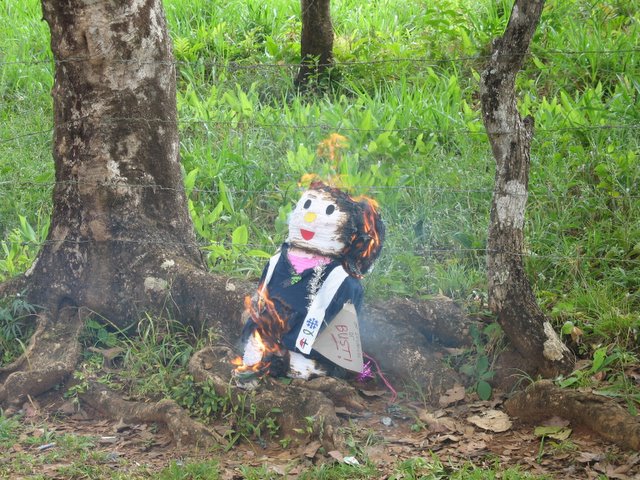 Not wanting to be outsiders to their culture, and wanting to understand more about the people we were working with, we decided to to create our own effigy of Bishop Willimon. You can see in the picture "Bishop Kitty" holding a sign saying, "8 Districts or Bust," in reference to our upcoming called Annual Conference. The stole was expertly crafted by Amanda vonHermann, guaranteeing that her husband, Peter, will be appointed to the Roanoke District once he graduates from seminary.
Fortunately Bishop Willimon took this in great stride and had a good laugh about this. Although, I fully expect to hear this in an upcoming sermon from him about how the young clergy of this day are so radical that they have no respect for authority. We all got a good laugh out of it, especially the Last Will and Testament, created by Brandon Harris. (I hope to get a copy of it to post here soon.)
Conclusion
Of course this is only a small representation of the sights that we saw there in Panama. The countryside was beautiful as well as the coastal area. But, like anywhere, there was evident disparity between the haves and the have-nots.
Overall, we were welcomed by the Panamanian people as we wandered through their country like the clueless gringos we were. This was somewhat surprising, considering how the U.S. had contributed in no small part to the economic and political struggles the country has had in years past. I don't know about you, but I wouldn't have been so friendly to people from a country that had invaded mine over 20 times in the last century. Despite this, the people were extremely kind, welcoming, and ready to show how proud they were of their country.
Panama: Food and Dining
As much as Laura and I like to travel to different places to see the sights and experience different cultures and the history of places, trying different foods is also a big part of it.
The whole time we were in Panama we only ate in one McDonald's - thank God. Maybe I'm a bit of a travel snob, but I don't go to a foreign country to eat American fast food. Luckily we were able to avoid most of it, especially during our 12- and 8-hour bus trips to and from David. That, in part, was due to the fact that in the middle of Panama on the Pan-Am highway, there aren't any fast food places, at least in the sense of what we know them as. Most restaurants were family run and seemed to have pretty much the same menu from one end of the country to the other. These weren't chains, but by the end of the trip we didn't even have to look at the menu at any of the places because it was all the same. Fish, Shrimp, Filets (cut very differently there than here), and the occasional squid and lobster. The menus only varied in how many different ways they prepared the items.
The food was tasty enough in these places, I'm sure it would have been a lot better had they not been trying to accommodate a party of 20. But there were a few snags here and there. I really hate eating in very large groups. From my time in the food service industry, and from eating with groups of people who are clueless when it comes to restaurant etiquette, parties of eight are my limit. More than that and you can guarantee that somebody is not going to get what they ordered. Add to the fact that most of the places we went, the people spoke no English, eating out was an ordeal.
Though the restaurants were not as great as I had hoped, the food prepared for us by the women of the host church in David and the women of the Chiriqui village where we worked, was amazing. Fresh fruit and vegetables everyday, chicken and rice dishes, beans, sausage, breads, and strong coffee every meal, really gave us an authentic taste of Panamanian foods. It must be universal that Methodist women know how to cook and feed lots of people because these women did not disappoint.
They were so gracious and kind too. These women were up early to fix breakfast for us, and up late, waiting on us to get through with our work to feed us.
No corn syrup in my coke please. I loved the fact that the local Coca-Cola products (and I would guess, all soft drinks) were made with real sugar - not the high-fructose corn syrup that we get here. It was a much better tasting Coke to me and in a strange way, felt healthier. (If you're in doubt, read "Fast Food Nation" or see "Super-Size Me." I've heard Coke with sugar is a rare find stateside. It usually can only be found either around Passover with a yellow cap, or in Mexican markets. In just the same way the corn producers dominate the market here, sugar is in much more abundant supply there. So, it stands to reason that they would use a more local and cheaper sweetener. It definitely produces a better product with the sugar.
The final day of working in Chiriqui, we had a community-wide meal and invited the children of the surrounding area. The meal - beans and rice. It was like heaven. Three local women prepared close to 25 pounds of beans and 10 pounds of rice for all of the people there. A great feat in and of itself, but they did it using an outdoor, wood-fired "stove." It was amazing to see how they were able to prepare the food so well in the huge pots that they had while managing the heat with banana leaves. Definitely one of the best meals of the trip.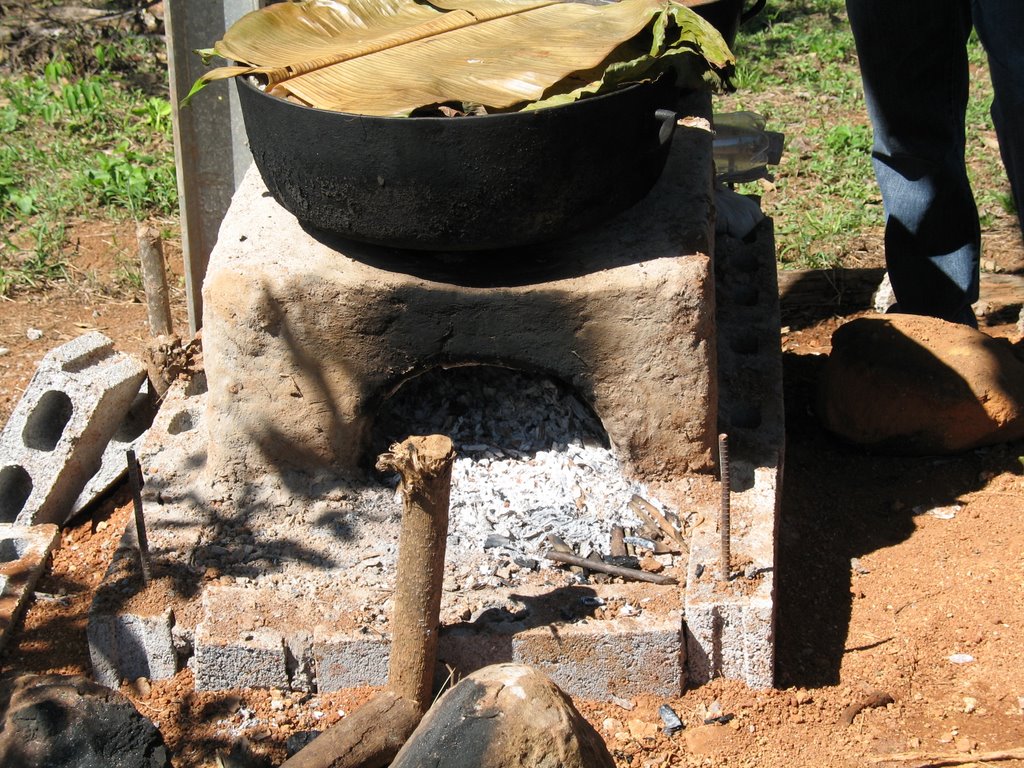
Panama: Final Thoughts
 Yeah, so I've sat on this for a long time. There's more, but I'm not feeling it right now. Hope that whoever is Jonesing for an update from me, this will suffice...
To sum up, we had a great time. Though it has taken about two weeks to fully recover from the trip and from the Christmas holidays preceeding the trip, all of the stress was well worth it.
I know I would love to go back to work, but I am certainly grateful for the opportunity to have spent time with peers and getting to know some of the other folks better.
Click here (Right-click to download) to see the .WMV PhotoStory of our trip. Windows Media Player required. WARNING! This file is 7.1 MB, so be prepared for a long download. Also, all songs are copyrighted by their repective artists (Van Halen, Michael Tolcher, House of Pain, Big Country)
Friday, January 06, 2006
We're back!
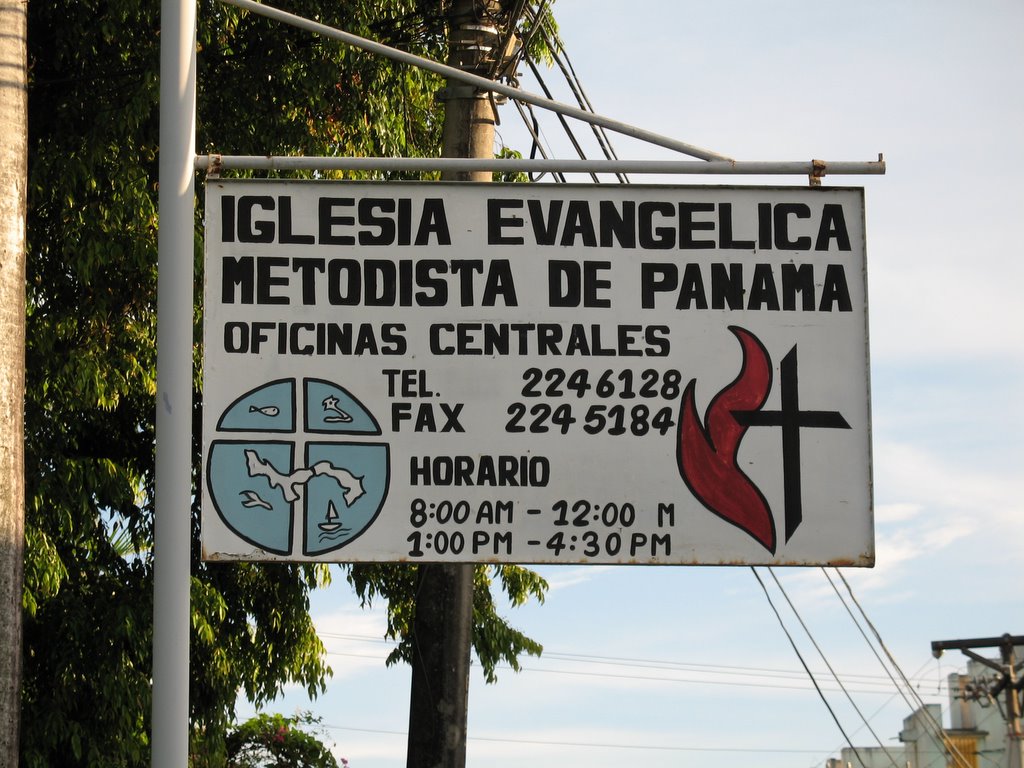 This is Panama. (Actually the Central Offices of the Evangelical Methodist Church of Panama.)
This is where we stayed for the first night we were there, as well as the last two nights. The in between days, when we were working with the Ngobe Indians, we stayed in a hotel in David. Overall, the lodging conditions were much better than expected, especially in David. The only drawback to staying at a hotel was that it made it that much harder going back to the central offices and sharing a bunk with Bishop Willimon rather than Laura.
I had a great time on the trip. We just tried to do too much in too short of a time.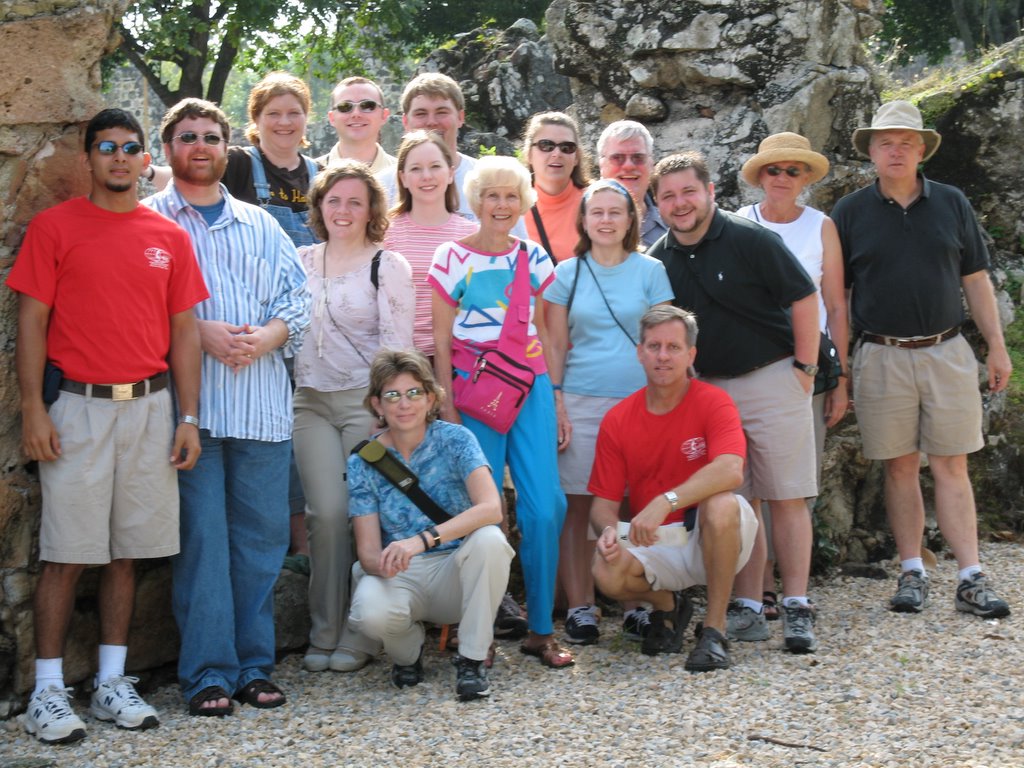 We weren't able to fully complete our intended project of painting a multi-use building on the Indian reservation, but we were able to do a lot for the children and the families that the building served.
Because this was a multi-purpose trip, trying to blog straight through the trip would be next to impossible, and very unreadable. So, my plan is to do a summary in segments, addressing different topics and aspects of the trip. It's about the only way I know how to make sense of all that we did, and will help me to properly reflect theologically on what we were able to do and see. Plus, it will allow me to post more pictures.
Expected topics will include: Purposes, Mission and People, Team building and bonding, Sight-Seeing and Customs, Food, Final thoughts. Of course, these ideas may change. Also, any specific questions concerning our trip will help in making the summary more coherent.
 Yes, this is a picture of a "Hello Kitty" pinata dressed as Bishop Willimon burning and filled with firecrackers. (More on this in the customs section.) The sign says, "8 Districts or Bust!"
Thursday, January 05, 2006
$12.50 for an undershirt
Apparently that's what I'm going to have to pay to live up to Gavin's nomination for being Best Dressed Blogger.
Before leaving for Panama I bought a pack of Hanes crew neck T-shirts from Target. I've only worn a few, and for the most part they felt alright. But, the one I pulled out today looked like they stitched together two shirts of different sizes. I swear, it felt like I was wearing the T-shirt version of the Gordon Gartrelle imitation that Denise made for Theo. I know I'm not THAT misshapen.
I know, I should probably be spending more on nicer undershirts anyway, so as to live up to my best dressed expectations, but as hot as it is here most of the time in Alabama, and as much as I sweat, I can't afford to be that guy yet.
Here's hoping that the shirts in the rest of the pack at least have the holes in the right places.
Friday, December 23, 2005
Journeys
No, not the band.
Laura and I head out today for what will be an eleven day tour, spanning, Tennessee, Alabama, and the country of Panama. We're looking forward to it all, but I'm already getting tired thinking about all the places we'll be going.
We will be spending most of those 11 days in Panama, with several of the younger clergy from the North Alabama Conference, and Bishop Will Willimon. This is part of a UVIM training trip with the idea that we will be trained to be group leaders so as to be able to take other groups to Panama to do missions. Also, the Bishop wanted this time to spend with the younger clergy so as to get to know us better and to have a dialogue about the changing face of ministry. If anything, it should at least an interesting trip just to see a different part of the world.
So, Merry Christmas to all, Happy Holidays, Seasons Greetings, and for the rest of us, Happy Festivus! I will be back next year with updates and a journal of our trip.
--MATT
Wednesday, December 14, 2005
Redistricting
Last night, Laura and I went to a meeting at Wesley Memorial UMC in Decatur, AL concerning the re-districting of the North Alabama Conference. We went, like many others, hoping to get some details about what this new structure was going to look like. All I knew was that there had been a study committee appointed a couple of years ago to look at what several other committees had looked at over the past 30 years. And, that this committee had made the recommendation to reduce the number of districts from 12 to 8.
I guess you could say that the theme word for the night was "fluff." At several points during the two-hour meeting it felt very much like we were at a political press conference. It almost became humorous the number of times their "talking points" were repeated. "Vision" this, and "challenge" that. "Trust" and "empowering leadership" were also up there.
The whole point is this, the North Alabama Conference has lost over 30,000 members in the past 30 years and the current structure is not cost effective. Though the number of churches have stayed the same or have increased, the number of people in those churches have decreased and financial resources have become increasingly limited. The committee picked the number of new district to be 8, so as to best re-align our existing resources. However, no rationale was given for the choosing of this number, nor what the new District structure would look like. The only information that was given was a new vision for what the role of the District Superintendent (DS) ought to be.
The whole focus of the presentation was about how the new structure would allow DSs to do less administrative work and more coaching and ministry. It sounds good, especially with the challenge to local churches to be more connectional and cluster their resources and ministries. But, the confusion still lay in the apparent paradox that somehow the DSs were going to be able to have more time to do this when the number of churches that they were responsible for increased.
After a while, after an hour of talk in generalities about how clustering and sub-districting would allow DSs to be more efficient in training several churches at once instead of one at a time, the people there were finally beginning to get it. THEN, Dale Cohen (the Director of Connectional Ministries) "mentions" that to help the DSs they would have an assistant to help in the administrative work. This goes over like a lead balloon because we had been talking all night about cutting costs and now they're talking about adding 8 more people (as assistants) to the mix - an overall INCREASE of 4 people! Not many people heard it, but supposedly the assistants won't be paid, or might even be shared among the Districts.
Granted, I get that our current structure is not working and we need a change, but two things have been very frustrating. One, there was very little, if any real information was given. The people just wanted to be able to say, "OK, this is what the new structure is going to look like and this will be what the new role of the DS will be. And, this is where we plug in as a local church." Granted, that's not what the vote will be bout in January at the Called Annual Conference (the conference can only vote on the number of districts, not the structure), but there was nothing that people could sink their teeth into and say, "This new idea might work." There were no ideas, just concepts, and, when you are talking to people in the Decatur and Huntsville Districts, you'd better give those Rocket Scientists something more than just a buzzword to plug into their logic.
The second thing that has bugged me is something that came up during our Order of Elders Meeting: trust and the trust that comes through communication. I could sense a deep feeling of mistrust by many in the auditorium that they were skeptical that reducing the number of districts would solve our Conference's woes. The reality is, is that there are a number of things that need to be addressed before the Conference is doing ministry as efficiently as it could be. There were many, like me, that were thinking, "Why are we focusing our time on this, when there are more pressing needs facing our local church's ability to do ministry?" Things like the skyrocketing cost of the mandatory pastor's insurance, the role of the pastor and the local church, and new ways of looking at itineracy, these affect a local church much more than how many districts we have. I hope that these things will be addressed soon by the Conference. I know that this will probably be one of the many conversations that I will be having with the Bishop as we and several other young clergy go on a mission trip to Panama.
By reducing the number of districts to eight, the conference will save close to $300,000 when all is said and done with salary, insurance, housing, etc. for DSs. but, how that money will be used is the question. It would have been nice to have heard just one program, event, something that these newly re-aligned resources would be able to provide. Just something that was on the books and we could see how it would make a difference in doing ministry in the North Alabama Conference.
Going to eight districts will not fix all of our problems, maybe not any of them, but I do hope and pray that this truly is a start in the right direction. At least serving as a wake up call to the whole Conference that we need to do something different.
Message from Bishop Will Willimon concerning Redistricting
Tuesday, December 13, 2005
'tis the Season?
John 1:6-8, 19-28
Apparently, unbeknownst to me, there is a war going on. No, not the war in
I’ve read a lot of articles over the past week and a half, seen loud-mouthed commentators on TV, and even heard people discussing it as they were doing their shopping, over whether or not Christmas was in danger. Frankly, I’ve been quite amused. Of all the holidays in the world, Christmas is not only one of the largest, if not THE largest, but it is also celebrated by more people than any other holiday in the world. I don’t think there’s any danger of losing Christmas, if we did, every major retailer would be put out of business. They wouldn’t make any money.
And really, that’s what’s driving this whole thing that’s going on. Money. Money and publicity – which translates to more money.
Ahh, I remember not too long ago, a simpler time, when Christmas was about preparing our homes and spirits for the Prince of Peace. We retold the stories about how God loved us so much that he sent his son in the form of a baby to teach us how to live and be in relationship with God and each other. We would listen to the hymns about baby Jesus in a manger, the shepherd, the wise men, and how hard it is to find a hotel on Christmas Eve. And we would hear preachers rant about the commercialization of Chrstmas. Now, the stories are about which stores are saying “Happy Holidays” or “Merry Christmas.” And it seems our salvation is based, not on the Resurrected Christ, but on where we decide to shop.
I’ll be honest with you, it doesn’t bother me a lick when I hear someone say, “Happy Holidays.” I say it myself. I don’t mind it for several reasons, one because it’s a sign of tolerance and understanding, and two, for what the word “holiday” really means.
The word “holiday” is a shortening of the words “holy” and “day” – “holy day.” At Christmas time, we are focusing on one particular day, but aren’t all the days leading up to it pretty special? I mean come on, we’re not burning these candles in the wreath for nothing, people! Even the days following Christmas day are pretty special as they lead up to Epiphany. So, when I hear “Happy Holidays,” I’m not only hearing well wishes for people of other faiths as they celebrate their own traditions, I’m hearing a reminder that we are in the midst of a very special time that cannot be contained in just one day. Happy “Holy Days,” indeed.
Our gospel text again turns to John as we are reminded of the holy days that he lived in. I wonder how many others felt it. If there was an energy in the air? A buzz, or a feeling that something amazing was about to happen? I imagine too, that like us, there were some who knew that something special was going on, but they were looking in the wrong place, distracted by all the flashy lights and the people who were trying to yell louder than everyone else.
John was out there in the wilderness, baptizing people, getting them to repent, and helping them come to a new relationship with God. He was reminding people to worship God and not themselves or the Pharisees. But of course, the Pharisees didn’t like that, John was cutting into their profit margin. So, they send out the priests and Levites to do their dirty work and undermine John’s credibility. Rather than question the validity of what he was doing, they attack his character. It seems to be a pretty good indicator that your position is the reasonable one when the only thing the other side can do is attack your character. It’s a sign of them having nothing else to stand on.
So there is John, breath stinking of bugs, beard dripping with honey, and as humbly as a loud-mouthed wooly-booger could be, he says, “I’m doing this to help people recognize the Messiah when he comes. Most of you are too dense to even sense something special is happening, but for those who are ready, they will see something great!” Granted, that’s from the New Reed Version of the Bible (in stores in time for next Christmas), but that’s the essence of what he was saying. “I’m only preparing the way and pointing people in the right direction.”
It hurts me to see people heading in the wrong direction. I’m not just talking about the “Happy Holidays” thing, but headed in the wrong direction in their lives. People who are living without a relationship to God and are wasting it on self-centeredness. You see it in many forms, from addiction and abuse, to greed and power-hunger, to wanting to impose their viewpoint on everyone and eliminate everyone who disagrees, we’re a pretty self-centered bunch.
That’s not what Christ offers. He offers an alternative to focusing on our needs. He offers a relationship that is based on love and hope. A relationship that eliminates the need for mindless indulgence with an invitation to focus on God.
And that’s what Christmas is about. The ultimate form of someone reaching out to be in relationship and love with someone. Christmas should grab our attention, set us on the right path, and remind us that God reached out to us in self-sacrificing love and that we are called to do the same. Christmas reminds us that God loves us so much that he put his life on the line for us.
I saw an article this weekend that gave me hope that the spirit of Christmas is not dead. From Reuters in
However, despite these fears and thoughts of dangers in years past, something amazing has happened. A youth wing affiliated with
The spirit of Christmas is not dead, it just seems that non-Christians are the ones who have it. Would you be willing to stand guard for someone of a different religion? Would you put your life on the line as Jesus did?
We are in the midst of some very Holy Days, open your eyes and see the path of truth that leads us through the wilderness.
Sermon delivered 12/11/2005
Wednesday, September 21, 2005
Why did I do this?
| You are a Social Liberal (66% permissive) and an... Economic Liberal (15% permissive) You are best described as a:
Link: The Politics Test on Ok Cupid |

Katrina Relief
So, I'm going to be going somewhere in LA or MS with half of the clergy of the North Alabama Conference to help in the Katrina cleanup. We've been "trained" to be first responders, so that we now have the credentials to go anywhere there is a major disaster. I feel real qualified. That hour-and-a-half I listened to that blow-hard, asshole, retired minister, while playing solitaire on my phone really prepared me.
We'll be somewhere where it is stinky and hot from Oct. 2 - 6. I'm glad to be able to help, and I am excited about being able to do something, but the others who will be going from the Florence area can be less than tolerable sometimes.
Keep supporting UMCOR and the Red Cross.
Tuesday, September 13, 2005
Sunday, Sept. 4, 2005
I know that I am backdating a bit, but I have been wondering about the appropriateness of me posting a sermon concerning the hurricane on this site.
I was having trouble deciding on how to approach the subject of Katrina and other natural disasters this morning. Should I try to address questions of theodicy and ask why natural disasters such evil can happen in a world that was created by a good God? Or, preach a sermon about compassion and social justice?
In some ways I believe that these two things are at least somewhat related. Don’t get me wrong - in no way am I setting up this idea to say that evil happens so that good can come out of it. Let’s just stop that there. I believe that God isn’t that cruel. Granted, Romans tells us that all things work together for the good in the end, but that’s in the ultimate big picture. I’m talking about now. Sure, we want to provide a reason for why something bad has happened, but the loss of thousands of lives to bring about a new understanding of God - I don’t think so.
When we blame God for natural disasters, when we call chaos an “act of God,” we portray our Creator as a destructive and terrifying foe.
Now I admit, maybe it is too easy for me to talk like this. Those of us who are not experiencing suffering have to be very careful when we talk about what it means to suffer. I am very aware of the fact that I am waxing poetic about the theological meaning of a hurricane when I am thousands of miles away, dry and unscathed. I have no right to tell someone who has lost everything in a natural disaster that it is inappropriate to be angry at God. Yet I believe that even as the shouts of frustration and cries of pain are hurled at God, God continues to console the inconsolable. God continues to be an ever-present source of strength and courage and comfort and peace.
My sermon title this morning comes from a book that a pastor, who has now become a friend of mine, wrote about ten years ago.
You may remember the Palm Sunday tornadoes from 1994, some of which struck Goshen Springs Methodist Church, killing many members, including his daughter. In his book, Dale describes the grief that he and his wife, who was the pastor of the church, went through after losing their daughter and many members of Kelly’s congregation. The book also describes the literally thousands of letters people wrote them, trying to make sense of what happened.
As you can imagine, few of those letters were helpful. Theories of all different kinds poured in. Some blamed the fact that Goshen church was pastored by a woman. Others weren’t so harsh and tried to offer comfort through clichés that were empty in faith. And others simply told them to deny God altogether. In their own way, all of them were trying to make sense of what had happened.
To me the book was helpful in pointing out how little we really see God. Dale says that most all of the people who were asking questions about faith asked pretty much the same question, “Where was God in all of this?”
After a long time of searching and praying, he finally came to a conclusion. God was not only there with them during the tragedy, but was with them before and after. As he began to witness the outpouring of love and compassion, he began to see where God was working through the hands and hearts of the people around him.
There is a plaque at the Goshen Springs Methodist Church in Alabama that reads “Sometimes God calms the storm. Sometimes he lets the storm rage and calms the child.”
What Dale found, and what I have found in my own experience, is that for the most part people who say that they believe in God, go about most of their lives thinking about and experiencing who God is. God is more of a vague shadow, even in the lives of Christians, than an ever-present comfort and guide that he promises to be. And, since we are pretty lucky and spend most of our lives without tragedy, we tend to “overlook” God for the most part. So, when the time comes that we need to look to God for support and comfort, it’s not that God isn’t there, we’ve just forgotten how to look for him.
I don’t know why God lets bad things happen. But I do know that when bad things happen, the people of God react differently than those who don’t know Christ - or at least they should.
As we consider the role of God in this disaster, we must also consider the role of humanity. In addition to the primary disaster of the hurricane, we have also observed many deplorable responses to the havoc. The nation is truly in an uproar. Stories of unbridled looting and unspeakable violence bear witness to the human capacity to sin. Yet God continues to love our broken humanity. Furthermore, the slow response to deliver aid to the mostly impoverished minorities who were unable to leave New Orleans has given rise to significant questions of justice.
But even then, we have already seen, even through the tragedy and slow government response, an amazing amount of money, assistance, compassion, and love have been given by people of all walks of life. So when people ask, “Where is God in all of this?” I believe that God is in the hands of those who have responded. In the hands of those who are giving out food and water to those who haven’t eaten in days. In the prayers of those who are unable to lift or rebuild. In the arms of those who hold a newborn baby or comfort a man who is slowly dying.
Yes, we have seen a great amount of destruction caused by nature and caused by people, but already there have been signs of God’s love and grace, even as the water covers many places and people.
We have an opportunity to be agents of God’s grace. Through our prayers, we can pray for the comfort and healing of those who have been affected. Through our hands we can help feed those who have been displaced and can help rebuild when the times comes. And through our gifts we can not only provide the resources for beginning recovery, but resources that will help continue and sustain those who return to nothing.
This morning, as an act of outreach and love and being agents of God’s grace, we will have the opportunity to help those in need through our gifts to the United Methodist Agency, UMCOR – the United Methodist Committee on Relief. Any money left on the altar rail this morning as we come to partake in communion, will be sent to UMCOR to help in the aid and rebuilding efforts for those who have been affected by the hurricanes. In addition, there is opportunity to help through assembling health kits, meals, and flood buckets.
Let us come to God’s table partaking in the Body of Christ and being reminded of how we can be Christ’s body for the world.
Wednesday, August 31, 2005
So we survived
The winds and rains were bad enough here, but certainly not devastating. There were some branches down, we lost a gutter spout, and there was trash and other debris, but that was it.
We did lose power Monday night around 9:30. Laura and I stumbled around the house in candlelight for a little while before going to bed. As we were getting in bed, Laura asked, "So, are you ready for me to blow out this last candle?" As she was taking her breath, all of a sudden the power comes back on and everything starts beeping and running again. Great lungs my wife has!
I hope everyone is OK. WHUMC is trying to send some relief funds and materials through UMCOR.
A Peculiar Prophet: Patriotic Thoughts
A Peculiar Prophet: Patriotic Thoughts
The Bishop has posted some interesting thoughts on patriotism in his weekly blog. I agree with him completely, but it is easier said than done.
Of my congregation, I would say that 70% of them have had some type of involvement in one war or another. I have found it a tricky place to try to navigate away from outright nationalism, to moving toward a more appropriate acknowledgement of those who have served and are serving now. My biggest confrontation had to do with a song the choir director wanted do to as an anthem called, "The Bible is my Statue of Liberty." Luckily, I convinced her that a more appropriate song might be "This is my Song," by Lloyd Stone and Georgia Harkness (pg. 437 in the UMC Hymnal) - which is my favorite song of all time.
However, at the same time of not wanting to have a U.S. flag waving ceremony in the church, I am thankful that at least this is not an area where putting up a US flag would be considered a political statement. A pastor was telling me about a former church that he served that the area that he was in was covered in Confederate flags and the culture, stereotypes, and racism was so pre-Civil war, that to put up a US flag would have been radical move.
My hope is that one day I can re-experience what I saw at the 1st Peace Camp in 1992. During worship one evening, we had a parade of flags from just about every nation in the world, with people running with them throughout Hutto Auditorium, and then out of the building. It was amazing, just the sheer beauty of it alone, but also that it symbolized that we had all been brought here from different locations with different flags, but were now here together, not under different flags, but one cross.
Sunday, August 28, 2005
An eye for an ...
Romans 12:9-21
The main reason we are angry is because we don’t know how to forgive.
I was scrolling through the TV guide the other day and I saw yet another judge show. People’s Court-type thing, not American Kennel club or American Idol. I’m fascinated with how many judge shows there are that are on TV. I still can’t get over that there is one station that runs almost three hours of “judge shows” right in a row. The show in question this week was called “Eye for an Eye.” It was a judge show about getting even with someone who had done them wrong.
I just want to say that if we truly believe that we are a Christian nation, then a show called “An Eye for an Eye” would not be airing on a Christian network. Aside from running a half hour program running down the Top Ten Gods that are better than Yahweh/Jehovah, you can’t get more un-Christian than a show called “An Eye for an Eye.”
Let’s remember what Jesus says in Matthew 5. He says, “You have heard that it was said, ‘An eye for an eye and a tooth for a tooth.’ But I say to you, do not resist an evildoer. But if anyone strikes you on the right cheek, turn the other also; and if anyone wants to sue you and take your coat, give your cloak as well; and if anyone forces you to go one mile, go also the second mile. Give to everyone who begs from you, and do not refuse anyone who wants to borrow from you.”[1]
To me, that’s pretty blatant. I’m not the smartest person in the world by far, but it’s pretty cut and dry that Jesus condemns the practice of getting even.
Why would God do this? Why would God first establish 2,000 years of Mosaic Law that was based on this notion of getting even, only to undo it in one fell swoop through Jesus?
It’s about mercy.
Jesus came to help people understand more about God’s love than what they knew in Scripture and the Law. Under those early laws, God had allowed people to take revenge that was equal to the harm that had been done to them. Thus, “an eye for an eye, a tooth for a tooth.” But God does away with that. He says, “No more!”
Why? Well, I’ll ask God when I meet him in heaven. I have no idea, but I’ll venture a guess. Human nature is such that when we are hurt, when we are angry, and we are given an opportunity to exact a revenge that was equal to the harm that was done to us, then we usually don’t stop with an equal and opposite reaction. No, we usually take it a step or two further than we should – call it interest.
I remember in elementary and Jr. High when I or one of my buddies would “accidentally” hit the other, the one who got hit would get to take a swing at the one who punched first. But it never failed that whoever got to hit back would always hit harder than he got hit, so the other would hit him, and so on and so on until someone else had to break it up. There would have never been an end to it, because both of the guys wanted to get in the last hit, and they wanted their punch to hurt the worst. An equal repayment of the hurt was never in their minds.
In many ways that’s where Jewish Law stood after 2,000 years of practice. It had been reduced to nothing much more than a bunch of boys on a playground. The Holy Law had been manipulated so that the repayment of hurt was no longer equal, but selective and oppressive. In addition to that, the Romans were oppressing the Jews and treating them unfairly, so therefore, the ones on power would turn and hurt the ones who were under them. The “punching on the playground” began to cycle out of control.
And that’s really what anger and violence is anyway, isn’t it? A continuation of the cycle of someone wanting to pay back the hurt that had been done to them. It’s in our human nature to want to get even. It’s one thing to say that we forgive, but we still feel hurt, we still feel pain. And, in a very real part, forgiveness isn’t really that fair is it?
We prayed earlier this morning that God “forgive us our trespasses, as we forgive those who trespass against us.” We’re not talking about our neighbor who parks his car on our freshly mown grass here, we’re talking about the people who have hurt us – just as we have hurt others.
It’s hard to forgive when we are hurting. When the pain is fresh or when it has festered for years, it’s hard for us to not remember someone who has done us wrong.
In Pastoral Counseling, one of the ideas that we talked about is that most people operate using a ledger system. Essentially we keep a list in our heads of all the bad things that have been done, and at any time we are ready to rattle off all those times that someone has done us wrong. I’m sure you know people who are professionals at that. Men, stop thinking about your wives, because you do it too. We all do it, the instant we get into an argument, all of the things that we have kept stored up in our minds come out and the avalanche begins.
But even then, once we get through with our litany of sins against us, we still hold on to them. We may have gotten them out there on the table, but we still hold on to them – ‘cause we know that we’ll have to use them again. So on and on it goes as we remember all of the bad things that happen to us.
So break the cycle. You have the power to put an end to the cycle of hurt and pain that exists in your own life. You’re tired of hurting, tired of being angry, tired of other people being angry at you? Why don’t you tear up the list? Get rid of it. Put to rest those things that we’re holding on to that we’re waiting to use against someone at any time.
Why? Why should we do this? Why should we be the ones who have to give up our quest for vengeance and blood thirst? Why not the other guy? Because Jesus did it first for us.
Of the many things that Jesus came to do, the most important of his works was to show us that God’s love was so genuine for us that no matter who we are or what we had done – we are forgiven. In the name of Jesus Christ, you are forgiven!
Jesus came to break the cycle. That’s the first reason that we forgive. It’s not fair, I know. But if you want a fair religion, try Buddhism or Hinduism, theirs is a theology based on getting even through karma and reincarnation. But the Christian faith isn’t easy. It’s hard. But it’s the best way to break that chain that can go on and on.
We forgive because God has forgiven us first. We forgive because God has forgiven us before we have forgiven ourselves. We forgive because we have been told.
A Sunday School teacher had just concluded her lesson and wanted to make sure she had made her point. She said, “Can anyone tell me what you must do before you can obtain forgiveness of sin?” There was a short pause and then, from the back of the room, a small boy spoke up. “Sin,” he said.
Before I close, I want to make sure that you know I’m not talking about the abuse of the idea of forgiveness. I’m sure Laura will touch on that when she shares with us about domestic violence. But what I am talking about is making those first steps toward finding wholeness in God and in yourself.
I will leave you with this verse from Romans 12:19. Paul is giving a number of commands and instructions on living and at the end he says, “Do not take revenge, my friends, but leave room for God’s anger, for it is written: ‘It is mine to avenge; I will repay,’ says God. Do not be overcome by evil, but overcome evil with good.”
“In the final analysis, forgiveness is an act of faith. It is the belief that God can take care of the fairness problems. It is not fair just to pretend that something doesn’t happen. It did happen. It still hurts. It still stings. Forgiveness is not fair, but forgiveness is a way of taking that burden from us and giving it to God who is fair. “I will avenge,” says the Lord. You forgive. It breaks the cycle of relationships. It breaks the stranglehold on you and on me and it is what God did for us in his Son Jesus on the cross.”[2]
[2] Phillip Yancey. “Forgiveness: It just ain’t fair” http://www.csec.org/csec/sermon/yancey_3622.htm
Saturday, August 27, 2005
I'm in it now...
So, here is the obligatory statement about how I have finally entered into the world of blogging because I am the only one who hasn't done it yet.
After doing CPE at UAB Hospital this Spring, I have adjusted my thougts about blogs. I still think that for the most part they are for either the self-obsessed or for people who have no one in their lives to share things with, but I can see a lot of benefit to them.
One of the things that got me rethinking blogs is that during CPE I was made aware that I am sometimes a "guarded" person - I don't reveal who I am very much. Well, I thought what could be better than starting to blog to get me to be more open about myself? So here it is, and here I am, with all of my naughty bits for the world to see. I doubt I'll update much, or that many people will read this, but in the long run, it may help me put off therapy in later years.
Enjoy!